
For NGO & CSR education programmes
Your proof already exists.
Thirty minutes, with the person who built it. Nothing to sign.
- ₹0 setup or onboarding
- 0% commission, ever
- 100% your data — export any time
- One live institute. No programme yet
Somebody already knows which chair was empty on Tuesday. They were standing in the room.
Everything below is about the distance between that and anyone being able to do something about it.
Who this is for
Start where you sit.
You run the centres
Free JEE, NEET or board coaching for government-school students. Several centres, one small team, and a funder who wants numbers every quarter.
What changes in the centreYou fund the programme
A company or foundation paying for classes it does not run. The money moves on time. The evidence rarely moves with it.
What you would get backYou report to a scheme
Empanelled under a free-coaching scheme — SC and OBC, minority, or a state one. Per-learner records, centre by centre, with the dates they were captured.
How this is paid forIn 90 seconds
The short version.
- What it is
- An Android app and web portal that a coaching centre runs on — attendance, tests, results, and a login for parents. Everything it records becomes a dated, per-learner file you can export in full at any time.
- Who it is for
- NGOs running free coaching centres, companies funding classes they do not run, and organisations reporting to a government free-coaching scheme.
- The problem it solves
- The record that proves a programme worked is written every day by the people running it, on paper, and is gone by the time a funder, an auditor or a Rule 8(3) assessor asks for it.
- Why it is different
- It is a teaching system first, so the record is a by-product of work your staff already do rather than a monthly reporting exercise somebody has to be chased for.
- How it is bought
- As software, out of project cost, against an invoice. We are a for-profit vendor and not a CSR implementing agency — Rule 4(1) reserves that for Section 8 companies, trusts and societies, and we are not eligible.
- What exists today
- All of the above, in daily use at one fee-charging coaching institute since May 2026. Their app is publicly listed on Google Play under their own name, so the deployment can be verified without asking us.
- What does not exist
- No funder dashboard, no read-only funder login, and no cross-programme filter by centre. No grant-funded programme has run on this yet — you would be the first. One engineer, and no source-code escrow.
- Indicative cost
- Quoted per programme rather than taken from our published institute rates. For scale, roughly 250 learners across three centres is typically ₹1–2 lakh a year, or ₹3–6 lakh bought outright, before GST. A one-centre, one-term pilot is a fixed ₹50,000.
- Why the risk is lower than it looks
- Your app, your Play Store account, your hosting account and your data are all in your organisation's name from day one. Start with one centre for one term.
- The next step
- Send us the report you actually have to file. We will tell you which columns come out of an export today and which would need building, before you commit to anything.
What goes wrong, and what changes
Same staff. Same centres.
In short — your team keeps working exactly as they do now. The record stops being lost.
Attendance
Today · On paper, in a register, in a centre. Head office finds out which centre thinned out in November once the year is over.
On this · Marked on a phone by the centre coordinator. Head office sees it as soon as it is marked — in live data, usually the next morning.
A learner slipping away
Today · They stop coming in week six. It surfaces a term later, and the seat you funded has been cold for most of it.
On this · Their absences sit in their own record, under their name, the same week — while it is still a week and not a term.
A test
Today · Marked by hand, then typed into a spreadsheet for ranks. Most of a teacher's week.
On this · Objective questions grade themselves on submission. Marks, ranks and the batch's spread come out together.
Parents
Today · Ring the centre, or hear nothing at all until results.
On this · Their own login: their child's attendance, results and alerts. No fee screen, because a free programme should never show a family one.
Counting a centre
Today · One marks by session, the next by day, the third at month end. The totals get added up anyway.
On this · One method across centres, and one named owner of the register in each.
The quarterly report
Today · Collect the registers, type the numbers, estimate the gaps. Four times a year.
On this · An export: per learner, unaggregated, carrying the date each row was recorded.
If you ever leave us
Today · Their app, their data, and a negotiation to get it back.
On this · The app, the Play Store listing, the hosting account and the records are already in your organisation's name.
None of that is a measured result. No programme has run on this yet, so we have no outcome numbers and we are not going to borrow anybody else's. Above is what the system does. The numbers would be yours.
Why records matter
A record is only useful early.
In short — the value of a record is almost entirely in how early it exists. Everything else follows from that.
- 1
Attendance is marked in the room, the day it happens
By the coordinator standing in it, on a phone, in seconds.
- 2
A gap is visible in week two, not at the quarter
Two missed sessions against a named learner, not a total at the end of a term.
- 3
The centre and the household both know
The coordinator sees it in the learner's record; the family sees it in the parent login.
- 4
Somebody asks why
This is the link that is not software. A record makes the question possible; a person still has to ask it.
- 5
The learner comes back, or the reason is on record
Either outcome is better than an absence nobody accounted for.
- 6
The cohort that sits the endline is the cohort that started
Which is what makes a before-and-after comparison mean anything.
- 7
The result is measured rather than estimated
From the same per-learner records, read twice, rather than from a recall survey.
Every arrow above is a mechanism, not a measured effect. Two of them are not software at all: somebody has to ask why, and somebody has to act. A record makes the question possible and cannot make it happen. No programme has run on this, so we have no completion figures — and a vendor showing you completion figures for a system with no live programme is showing you somebody else's.
The fastest way to test any of this against your own programme: send us the report or return you currently have to file, and we will tell you which columns come out of an export today and which would need building.
Send us the reporting format you fileWhat stops being manual
Same work, entered once.
- The quarterly report is assembled from an export rather than from collected registers.
- Marks are entered once, instead of entered, typed into a spreadsheet and then consolidated.
- One register per centre with one owner, instead of one method per coordinator.
- No monthly data call to centres, and no waiting on the centre that always replies last.
- No reconciling two spreadsheets that disagree about the same month.
- Parent queries answered by the parent, instead of by whoever is at the desk.
- A learner who stops attending surfaces while it is still a fortnight, not a term.
Deliberately no hours and no percentages. Each line is work that stops being manual; how much time that returns depends on how many centres you run and how you work today, and we will not invent a figure for it before a programme has measured one.
Why not what you have
Paper is not the problem.
In short — paper and Excel are not bad at this. They are bad at it across more than one centre.
A paper register
Better at · Never fails. No phone, no signal, no training, no power.
Where it stops · The record cannot leave the room — and across several centres, each one ends up counting differently.
Excel and a WhatsApp group
Better at · Free, and everybody already knows how to use both.
Where it stops · Assembled after the fact. No history against a named learner, and nothing records when a number was entered or by whom.
A school ERP
Better at · Timetables, transport, fees, one large campus.
Where it stops · Assumes one location and students who pay. A centre is not a campus, and a cohort is not a class year.
This
Better at · A per-learner record from week one, your own app, and exports you run yourself.
Where it stops · No funder dashboard yet, and no programme live on it yet. Both are named in full further down.
Comparing us against a commercial coaching platform instead? That comparison lives on the pricing page, nine lines of it. See the comparison
For the programme team
The day the centre has.
In short — the class first, the office second, the report last — because a system your coordinators resent will be half-fed by November.
Funding this rather than running it? skip ahead.
In the classroom
The week a teacher loses to marking and typing, given back to the room.
The assessment cycle shortens from a week to the same day — which is what makes correcting course mid-term possible at all, rather than discovering the problem at the end.
What that means day to day
- Tests set in the system, including real timed online papers. Objective questions grade themselves on submission.
- Marks, ranks and term-on-term trends from one entry — no spreadsheet in between.
- A doubt is a thread on the question, so the learner who would not ask in front of the class asks afterwards.
- Study material and announcements reach the batch, so a missed day is recoverable.
In the centre office
Every centre is its own class, with its own batches, staff and permissions.
Accountability has a name before anyone asks for one. When a funder asks who recorded a given day, there is one answer per centre instead of five.
What that means day to day
- Batches, timetables and teachers across every centre, in one place.
- Attendance marked on a phone, in the room, by the coordinator standing in it.
- Permissions granted person by person, because a centre coordinator needs attendance and marks and nothing else.
- A learner record that follows the child across terms, cohorts and years — so a returning learner is the same learner.
For the teacher
Their own batches, timetable and payslip. Nothing that is not theirs.
One screen to learn, which is what decides whether the system is still being fed in November rather than quietly abandoned by March.
What that means day to day
- One screen for marks, and the batch's performance visible the moment they are in.
- Their own attendance, leave and documents, without going through the office.
- Training is one recorded session, so a teacher who joins in October watches the same one.
Two things it deliberately does not do
Both are choices rather than gaps, and both are easier to hear now than on a demo call.
- A teacher cannot mark student attendance. It sits with whoever holds the Attendance permission — in a programme, the coordinator — so the register has one owner and the question "who recorded this day?" has an answer instead of five.
- Attendance is not automatic and not biometric. A reader in twelve centres has to be bought, powered and repaired, and one that fails quietly produces a gap you cannot tell apart from absence. A person marking a phone fails visibly.
In short — the household is the only party who can act on a week of absences while it is still a week.
Parents
The household can see in.
First-generation learners, and the household cannot see attendance, marks or even the timetable. The one thing that reliably keeps a child in the room is a family that knows what is happening in it.
What a parent actually sees
- A parent login showing their own child — attendance, results, alerts. Nothing about anybody else's child.
- No fee screen anywhere in it, because a free programme should never show a family a money screen.
- Results are released when your office chooses, so no teacher and no learner can publish marks early.
- Accounts are linked by your office, one pass for a whole centre. Nobody self-registers, which is also what makes the consent behind a child's account a record you hold.
At the one institute live on this today, the parent account is used more than the learner's own. That is one institute and it charges fees, so treat it as an observation rather than a finding — but it is the observation we have.
Where there is no phone in the household, nothing breaks: your staff enter attendance and marks, so the record is complete whether or not a single family ever logs in.
For the funder
A record, not a dashboard.
In short — you get rows, not a dashboard. The rows exist today. The dashboard does not.
- Step 1
The coordinator marks the batch
On a phone, in the room, in seconds — because it is the quickest way to mark a register, not because a report needs it.
- Step 2
It becomes a row, not a total
One learner, one date, one centre, one status. A total can be reconstructed from rows; rows cannot be recovered from a total.
- Step 3
You take it out yourself
Whenever you want, without asking us, and not only on the way out.
What you can get out
- Per-learner attendance from week one, carrying the date it was recorded as well as the date of the class — so a genuine gap can be told apart from a late entry.
- The same learner's score in March and again in September, from one record read twice rather than two separate surveys — the only shape that answers whether the programme moved anything.
- Enrolment, attendance and marks broken out by centre — so a centre that is drifting is visible before the year ends, not after it.
- Teacher and coordinator activity, because a centre stops being run before it stops being reported.
- Rows an independent assessor can sample-check against the centre, recompute any total from, and see the recording lag in — which is what makes an assessment rest on something.
That is the record, and it exists today. The screen that packages it does not — no cohort view, no intake-against-outcome, no login of your own. All three are named in full under What is missing.
One row, as it leaves the system
Sample data. No real learner or centre appears here.
| learner_id | centre | batch | class_date | status | recorded_at |
|---|---|---|---|---|---|
| TS-0142 | C01 · Ward 7 | JEE Foundation A | 2026-07-14 | Present | 2026-07-15 09:12 |
| TS-0143 | C01 · Ward 7 | JEE Foundation A | 2026-07-14 | Absent | 2026-07-15 09:12 |
| TS-0261 | C02 · Sadar | NEET Evening | 2026-07-14 | Present | 2026-07-14 19:40 |
Two of those three were marked the next morning — and the export says so.
Why they are two columns and not one
class_date and recorded_at are separate columns on purpose. One timestamp lets a whole month be filled in afterwards with nothing to show it happened; two makes back-filling visible, including ours. It is the difference between reading a record and reading somebody's summary of it, and it is the first thing an assessor looks for.
If you want to know whether these rows would satisfy your funder or your scheme, the quickest test is not a demo. Send us the format you file and we will map it column by column.
Send us the reporting format you fileImpact assessment
Rule 8(3) needs a source.
In short — above a threshold this is a legal duty. We produce the records it asks for. We do not do the assessment.
₹10 crore
Company obligation above which assessment is mandatory
The rule, in full
Average CSR obligation across the three immediately preceding financial years, above which a company must commission independent impact assessment.
₹1 crore
Project outlay above which it applies
The rule, in full
Project outlay above which that assessment applies, once the project has been complete for at least a year.
5%
Cap on administrative overheads
The rule, in full
The cap on administrative overheads for the financial year — which is not normally where a project's own monitoring costs sit. See How this gets paid for.
An assessment is only as good as the records somebody hands it — and what it usually gets handed is a recall survey run months afterwards. We do not carry out the assessment: it has to be independent, and having supplied the system we would not be. We produce the thing the assessor asks for first.
Companies (Corporate Social Responsibility Policy) Rules, 2014 — Rules 4(1), 7(1) and 8(3), as amended in 2021. Nothing on this page is legal, tax or audit advice.
How this gets paid for
We are a vendor, not an agency.
In short — CSR money can pay for this as procurement, out of project cost. Not as a grant to us.
- Cannot
CSR funds cannot be granted to us. We are not eligible to be your implementing agency.
How that works
Rule 4(1) lets a company route CSR only through a Section 8 company, a registered trust or a registered society — with 12A and 80G registration, a three-year track record and a CSR-1 number from the MCA. We are a for-profit software company, so we are not eligible and we will not pretend otherwise. If a proposal in front of you names a software vendor as the implementing agency, that is worth a second look.
- Can
CSR funds can buy this as a service, out of the project budget, against an invoice.
How that works
A project buys tablets, builds a classroom and pays a contractor; software is bought the same way, either by the company or by the implementing agency. The vendor on the other side of that invoice has always been a commercial one.
- Can
It normally belongs in project cost rather than the 5% overhead cap.
How that works
Rule 7(1) caps administrative overheads at 5% of a company's CSR spend for the year. Costs incurred to implement, monitor and evaluate a specific project are normally treated as project cost rather than overhead, which is where programmes budget this. Your CSR team and your auditor make that call, not us. For anything running more than a year, Section 135(6) also lets a company move an ongoing project's unspent amount into a separate Unspent CSR Account and spend it across the following three financial years — so a monitoring system bought inside that project carries the same horizon as the project.
If you report to a government scheme
The records are the shape those schemes ask for. We do not claim to emit any scheme's own return.
What the records do and do not cover
Per-learner enrolment, dated attendance, assessment scores and centre-wise rosters, all exportable unaggregated. What we will not claim is that the system produces a particular scheme's return in that scheme's own format — no programme has run on this yet and we have never been through one of those audits.
So send us the return you actually have to file. We will tell you which columns come straight out of an export today and which would need building, before you commit to anything.
Send us your reporting formatWhat your procurement team will usually ask us for
All of it on request, in the format your finance team files. Nothing here needs a conversation first.
- Quotation on letterheadScope, term and price, in the format your finance team files.
- GST-registered tax invoiceEvery figure we quote is exclusive of GST at 18%.
- PAN and GSTINFor your vendor master.
- Bank details for direct transferWe never take fee income or hold programme money.
- A written scope of workWhat is configuration, what is a build, and what is not included.
- A service agreementIncluding exit: 60 days of read-only access and free export at any time.
- Data-processing termsNaming your organisation as Data Fiduciary and us as processor under the DPDP Act, 2023.
What is not on that list, deliberately: we hold no ISO certification, no SOC 2 report and no independent security audit, so we cannot supply one. If your IT policy requires it, say so on the first call and we will tell you plainly whether we can meet it rather than finding out at the signature stage.
What it costs
Programmes are quoted.
In short — we quote programmes rather than price them off the institute rate card — and setup, logins, commission and exit stay at zero whatever the quote says.
Why it is not a rate card
- The published per-student rate assumes an institute collecting fees. A free programme has no fee income to price against.
- A grant has an end date and a subscription does not, which usually points at a one-time licence inside the project budget rather than a monthly bill.
- Several centres, and a cohort that turns over each term — not one campus with a rolling roll.
- Funders often need the cost to sit in a particular budget line, which changes the instrument more than it changes the amount.
What we never charge for
Fixed, and not part of the conversation. These four are why a quote is not an invitation to improvise.
- Setup or onboarding
- Teacher, coordinator and admin logins, at any number
- Commission — and in a free programme there are no fees to take a share of
- Exit, ever, and your data leaves with you
Whatever we quote excludes GST at 18%. A trust or society generally cannot claim input credit, so treat that as real cost rather than a pass-through.
Roughly what to budget
For scale: a programme of roughly 250 learners across three centres is typically a ₹1–2 lakh a year decision on monthly billing, or ₹3–6 lakh bought outright. Smaller programmes cost less and larger ones more. The figure you are quoted depends on your learner count, your number of centres and how long the funding runs — never on how large your organisation is.
The starter pilot is a fixed ₹50,000: one centre, one cohort, one term, including setup, the data import and training. It is deliberately sized to sit inside a programme manager's own approval limit rather than needing a committee.
As a share of outlay: about ₹1.5 lakh a year of monitoring on a ₹1 crore project is roughly 1.5% of it. Programmes normally budget that as project cost rather than against the 5% administrative-overhead cap — though as everywhere else on this page, that classification is your CSR team's and your auditor's call, not ours. All figures are before GST at 18%.
Tell us the number of learners, the number of centres and how long the funding runs, and you will have a figure on the first call rather than after three meetings.
Why us
What we actually believe.
In short — the app, the Play Store account, the hosting and the data are all in your name. Everything we would not do is on this page too.
Built from a real classroom, not a specification
Every screen was shaped by somebody who had to use it that afternoon. A version of attendance that took fourteen taps was rejected by a person with thirty learners waiting.
The app is published under your name, and the Play Store account is yours
Families should be installing your app, not ours. It also means leaving us costs you nothing you cannot carry out of the door.
You get the number on the first call
Institute rates are published in full on this site. A programme is quoted because it is a different shape — but you hear the figure on the first call, not after three meetings, and it does not move because you asked twice.
No commission, ever
We are paid for software, not for a share of what your programme does. In a free programme there is nothing to take a share of anyway.
One product. No tiers
Nothing useful is held back for a bigger plan. The exam engine and the payroll suite arrive with forty learners.
Your data leaves whenever you ask
Not only on the way out. A record you cannot take out is not really yours.
We publish what is not built
The list is three items long and it is on this page. A roadmap you can check is worth more than one you are told about.
You talk to the person who wrote it
Which is a risk as well as a benefit, and the next two blocks are about the risk.
Who you would be dealing with
Aditya Kotiwal
An IIT Bombay undergraduate, and the person who wrote every line of the product and of this page.
Where the product came from, and what came before it
It was not designed for programmes. It was built for one coaching institute, in the room, with the people who had to use it — which is why marking a batch takes a few taps. Adapting it for centres that charge nothing turned out to be switching a module off rather than building a different product.
Before this there was GymFlowX, built and sold to Truworth Health Technologies in June 2026 — and then handed over to somebody else's engineers, where it is still running. That is the part worth knowing: not that something sold, but that it survived being inherited. It is the same question you are asking about the next five years.
What you get is a direct number and answers on WhatsApp, usually within the hour. What you do not get is a 24/7 desk, an account manager, or a second engineer.
What is true today
No programme runs on this yet.
In short — everything above is in daily use at one institute. No programme has run on it. Three things are not built, and here they are.
In daily use
- Batches, attendance, the exam engine, results and the parent login all exist and are in daily use.
- At one fee-charging coaching institute, Zenith Pathshala, every day since May 2026. That is the whole customer list, and it is on our homepage too.
- No grant-funded, multi-centre programme has run on it. You would be the first.
Do not take that on trust. Their app is listed on Google Play under their own name — the developer on the listing is Zenith Pathshala, not TechShala, which is the same ownership arrangement your programme would get.
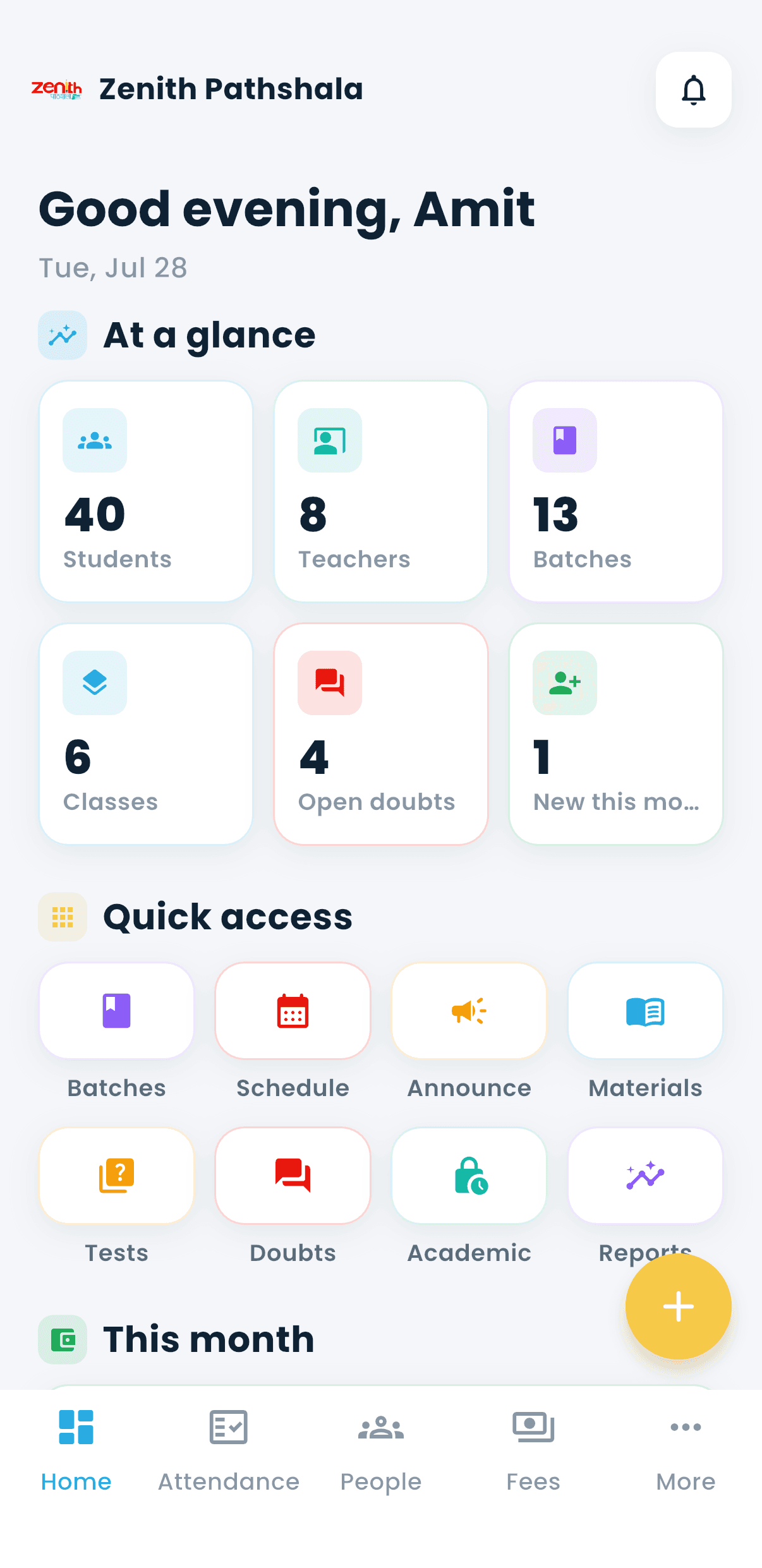
Zenith Pathshala's own app, on Play Store under their name. One institute, and the entire customer list. It charges fees rather than being a programme, which is exactly the gap this section is about.
See it on Google PlayNot built yet
The funder-facing layer is the honest gap. Three specific things, not a vague reporting story.
- Cohort views and intake-against-outcome comparisons. Today that is an export and a spreadsheet, not a screen.
- A read-only login for you. There are five logins — programme office, teachers, learners, parents, front desk — and none is an observer account.
- A centre as something you can filter a whole programme by. Every exported row carries its centre; there is no cross-programme report you can slice by it yet.
That is the whole list. We are not going to pad it with modules nobody has asked for, and we would rather build those three against one real programme's questions than call them finished here.
What going first is worth
- The funder-facing layer gets specified against your funder's actual questions rather than our guess at them
- You are the reference programme, and one we can show is worth more to us than five we cannot
- A direct line to the person who built it
Risks you should know before buying
What could go wrong.
In short — seven risks, what reduces each one, and what is left over after it. The last column is the one worth reading.
If TechShala disappeared tomorrow
- Your app and its Play Store listingYours — the developer account is registered to your organisationStays published and stays installable
- HostingYours — opened in your organisation's name, paid by you at costKeeps running as long as you keep paying the provider
- Your dataYours — exportable in full, by you, at any timeYou already have it, or can take it in minutes
- The software, if you bought the licenceBought outright, not rentedNo subscription to lapse
- Compliance updatesOursThis is the real exposure — see below
The honest exposure is maintenance. Google requires an app to keep up with recent Android versions or it stops being installable on new phones, and that is work somebody has to keep doing. Today that somebody is one person: there is no second engineer, and no source-code escrow arrangement. Your web portal, your data and your Play Store listing would all outlast us. The app would eventually stop being installable on new handsets if nobody maintained it. That is the most concrete risk of buying from a company this size, it is a fair reason to start with one centre rather than twelve, and you should hear it from us rather than work it out later.
| Risk | Where we stand today | What reduces it | What remains |
|---|---|---|---|
| One engineer | One person wrote the product and answers the phone. There is no second engineer and no support team. | A direct number rather than a ticket queue. Your app, Play Store listing, hosting account and data are all in your organisation's name from day one. | If that person stops, nobody is shipping Play Store compliance updates for your app. |
| No source-code escrow | No escrow arrangement exists today. | The one-time licence means the software is bought rather than rented, so there is no subscription to lapse and no switch for us to flip. | No third party is in a position to maintain the app if we cannot. |
| No live programme reference | One fee-charging institute in daily use since May 2026 — three months. No grant-funded, multi-centre programme has run on this. | Start with one centre, one cohort, one term, alongside whatever you use now. At the end you judge a real dataset rather than a demo. | You would be the first. There is no comparable deployment for you to go and inspect. |
| The funder-facing layer is not built | No cohort view, no intake-against-outcome screen, no read-only funder login, no cross-programme filter by centre. | The export is unaggregated and complete, so what reaches a funder can be checked against the source rather than taken on trust. | Until it is built, a funder is sent a file rather than given a login. |
| Attendance depends on a person | Marked by hand, not automatic and not biometric. In our live data the median record lands about a day after the class. | One named register owner per centre, and the export carries both the class date and the time it was recorded, so lag is visible rather than hidden. | A coordinator can forget. Nothing in the system prevents that; it only makes it apparent. |
| No security certification | We hold no ISO certification, no SOC 2 report and no independent security audit, and we do not claim otherwise. | Hosting is opened in your organisation's name and paid by you directly, so retention and access settings sit on your account. Staff restrictions are enforced in the database rather than hidden on a screen. | If your IT policy requires a certification, we cannot supply one today. |
| Parent visibility needs a phone | Some households have one phone, some have none. | Your staff enter attendance and marks, so the record is complete whether or not a single family ever logs in. | Families without a phone do not get the visibility the parent login is for. |
Data
These are minors. Four questions.
In the order a funder's legal team asks them, and the order your own board will.
Who owns the data?
You do. Under the DPDP Act, 2023 your organisation is the Data Fiduciary and we process on your instructions.
More on this
We are not a second organisation keeping its own copy of your learners. We do not sell data, we do not train anything on it, and we never move a learner's record out of the organisation it belongs to. Every demo runs on sample data.
These are minors. Who is responsible for consent?
You are — Section 9 makes verifiable parental consent the fiduciary's duty, not the vendor's.
More on this
Parent accounts are linked by your office rather than self-registered, so the link between a child and the adult who consented is a record you hold rather than an assumption we make. Section 9(3) also bars tracking, behavioural monitoring and advertising targeted at children: there is none of it in the product, and no advertising anywhere in it.
Who can see what?
A teacher sees their own batches. A parent sees their own child. A coordinator sees what you granted.
More on this
Those restrictions are enforced in the database rather than hidden on a screen, which means a permission holds even if somebody finds the URL. It is the core of how the system is built, not a setting somebody can turn off.
What if we leave?
You export everything yourself, at any time, and keep 60 days of read-only access after cancelling.
More on this
There is no exit fee. Exporting is free whether you are leaving or not — the point is that there is never a state in which your records exist only inside our system.
If none of that disqualified us, the next step is small. Send us the report or return you currently have to file and we will tell you which columns come out of an export today — no call, no commitment.
Send us the reporting format you fileIf you say yes
The first month, week by week.
In short — about a month, and we deliberately do not switch every centre on at once.
Week 1
Setup
What happens
An hour on a call: branding, centres, batches, staff, and which modules stay off. Your app, portal and public page get built, with the Play Store and hosting accounts opened in your organisation's name.
Week 2
Import and training
What happens
Learners and teachers come in from spreadsheet templates rather than being typed. One session for coordinators, one for teachers, both recorded.
Week 3
One centre live
What happens
A single centre runs on it for real — alongside whatever you use now, if you would rather not move everything at once. Attendance, one test, one round of parent logins.
Week 4
Review, then widen
What happens
We read the first three weeks of real rows together, fix what the coordinators complain about, and only then bring the other centres on.
The software side is days, not weeks. What makes it a month is the pace centres can absorb it at, and rushing that is how a system ends up half-fed.
What we would propose
One centre. One cohort. One term, at a fixed ₹50,000 including setup, import and training. At the end you have a real dataset and a real report to judge us on instead of a demo — and a figure small enough that most programme managers can approve it without a committee.
FAQ
What programmes ask.
Running it
Our learners do not pay any fees. Does that break anything?No. Fee collection is a module, and it stays switched off.
Nothing anywhere requires a learner to owe money, and no screen a teacher or a parent sees will mention it. If your programme handles something adjacent — a refundable deposit, a stipend register — that is configuration rather than a rebuild.
Is attendance automatic or biometric?Neither. A person marks it, on a phone, in the room.
Whoever holds the Attendance permission marks the batch — in a programme that is normally the coordinator rather than the teacher, so the register has one owner. In our live data the median record lands about a day after the class, and the export carries both the class date and the time it was recorded, so you can check that rather than take our word for it. There is no biometric hardware to buy or keep alive across centres.
Many of our learners do not have a smartphone.It does not matter. Your staff enter the record, not the learners.
Attendance, marks and results are entered by teachers and coordinators, so the record is complete whether or not a single learner ever logs in. Where a household does have a phone, the parent login is usually the account that gets used.
What about iPhones?An Android app, plus a web portal that works in any iPhone browser.
Every plan includes the branded Android app and the full web portal, which runs in Safari and can be added to the home screen. A separate branded iOS app is a paid add-on plus Apple's own fee at cost, because Apple's rules require each organisation to hold its own developer account. We would rather say that than imply an iPhone app is included.
We run several centres. Can they be kept apart?Yes. Each centre is separate — its own batches, its own staff, its own view.
A centre holds its own batches, teachers and coordinator, each seeing only their own while the programme office sees across all of them. That gives you per-centre rosters, attendance and results, and exports where every row already carries its centre. What it does not yet give you is a centre as a thing you can filter one cross-programme report by, which is named as a gap on this page rather than left for you to discover.
My coordinators are not comfortable with technology.Marking a batch is one screen and a few taps.
A coordinator sees their own centre and nothing else, so there is far less to learn than the whole system implies. Training is one recorded session, and you will have a direct number rather than a ticket queue.
Is there anything that could delay going live?One thing, outside our control: a 14-day Play Store review for new accounts.
Play Store makes a new personal developer account complete a 14-day closed testing period before an app can be published. An organisation that holds a D-U-N-S number registers as an organisation instead and skips it entirely. Either way the web portal is unaffected, so a coordinator can be marking attendance in a browser before the app is published.
What happens to the records we already have?Rosters import from a spreadsheet. Historic attendance and marks need a look first.
Learners and teachers come in from our spreadsheet templates rather than being typed in one by one, so a centre's current roster moves in a single pass. Historic attendance and past marks are a different job: whether they can be imported depends entirely on what format they are in today, and a register in a cupboard cannot be. Send us a sample of what you hold and we will tell you what can come across and what would have to start from the date you go live — before you commit to anything.
What hardware do we need to buy?None. A coordinator uses the phone they already have.
There is no biometric reader, no tablet and no card scanner to buy, install, power or repair across centres — which for a multi-centre programme is usually the right trade, because a device that fails quietly produces a gap you cannot tell apart from absence. Marking a batch works on an ordinary Android phone, and the web portal runs in any browser on any laptop the office already has.
We run more centres than that. Will it scale?Structurally yes — but our largest live deployment is one institute, and you should weigh that.
Nothing in the pricing or the structure penalises size: centres are set up as their own classes, staff and admin logins are unlimited and free, and there is no per-centre charge. What we will not do is tell you we have proven it at forty centres, because we have not. The honest position is that the architecture does not care and the track record does not exist yet, which is a real part of going first and is why we would start with one centre rather than twelve.
Funding, compliance and data
What will our procurement team need from you?Quotation, GST invoice, PAN and GSTIN, bank details, scope of work, agreement, DPDP processing terms.
All of that we can produce on request, in the format your finance team files. What we cannot produce is an ISO certification, a SOC 2 report or an independent security audit, because we hold none — so if your IT policy requires one, raise it on the first call and we will tell you plainly whether we can meet it rather than discovering it at the signature stage.
Can CSR funds actually be used to pay for this?Yes — as procurement out of the project budget, not as a grant to us.
CSR money reaches us the way it reaches the company that supplies a project's tablets: the company or the implementing agency buys a service, against an invoice. What cannot happen is CSR funds being given to us as an implementing agency, because Rule 4(1) reserves that for Section 8 companies, trusts and societies. Your CSR team will know the distinction; we state it so the first call can start past it.
Are you a CSR implementing agency?No, and we cannot become one.
That requires a Section 8 company, registered trust or registered society, with 12A and 80G, a three-year track record and a CSR-1 number. We are a for-profit software company. If a proposal in front of you names a software vendor as the implementing agency, that is worth a second look.
Do you carry out the impact assessment itself?No. Rule 8(3) requires it to be independent, and we would not be.
Having supplied the system that produced the records, we could not be independent of them. What we do is produce what the assessor asks for first: dated, per-learner attendance and assessment records, collected as the programme ran rather than recalled afterwards. The assessment stays somebody else's job, and it should.
Do we get our own login, or do we have to ask the NGO every time?Today you ask — and what comes back is the full export, not a summary.
There are five logins and none of them is a read-only funder account. That is the honest position, and an observer login scoped to the programme you fund is the first thing we would build with a funding partner. Until it exists, what reaches you can at least be checked against the source instead of taken on trust.
What happens when the grant ends?You stop, and you keep the records.
On monthly billing you stop after the three-month minimum, with no exit fee and 60 days of read-only access. This is the specific reason we point grant-funded programmes at the one-time licence: bought inside the project budget, the system and its records stay with you after the funding stops, which is also the answer a funder wants when they ask what happens to the data at project close.
Will you build the reporting our funder specifically asks for?Yes — and every programme after you gets it too.
That is exactly what we want the first programme for. Branding, cohorts, permissions and exports are configuration and cost nothing. Where a funder needs a genuinely new view — an intake-to-outcome comparison, a utilisation format, a scheme's own return — we will build it. What we will not do at any price is maintain a private version for one organisation, because that is what makes software slow and expensive and you would be the one paying for it.
You already have the record. This is a conversation about where it goes.
Start with one centre.
Thirty minutes with the person who built it. Tell us what your programme has to prove and to whom; we will show you the system on sample data and say which parts exist today and which we would build with you. If it is not a fit, we will say that on the call.
No deck, no trial account to configure, and nobody will call you afterwards unless you ask us to.
Or ask for it all in writing and forward it to whoever else has to agree.
₹0 setup · 0% commission · no exit fee · your data exports at any time